



How Material Hardness Changes Real-World Performance in Rubber Parts
Material hardness has a direct impact on how custom molded rubber parts perform once installed in real-world conditions. Hardness influences how a part seals, absorbs vibration, handles pressure, and resists long-term wear. Even with a correct design and material selection, choosing the wrong hardness can lead to early failure. Selecting the right durometer ensures reliability, better performance, and longer service life, especially in applications exposed to temperature swings, load variations, and continuous movement.
Understanding Rubber Hardness

Durometer tool measuring Shore A hardness on rubber.
Rubber hardness is measured using the Shore A durometer scale. Lower values indicate softer rubber while higher values indicate a more rigid material. Most molded applications fall between 40A and 90A. Hardness determines how much the material compresses or deflects when a force is applied, which affects sealing, shock absorption, and dimensional stability. For reference, there are established durometer testing standards that outline the correct methods for measuring hardness.
Impact on Sealing Performance

Comparison of soft and hard rubber seals compressing under load.
Softer rubber typically provides superior sealing in low-pressure applications because it conforms easily to mating surfaces and fills minor gaps. Harder rubber offers greater stability for high-pressure environments, reducing the risk of extrusion and maintaining dimensional integrity. When sealing issues occur, adjusting hardness is one of the first engineering considerations.
Compression Set and Long-Term Reliability
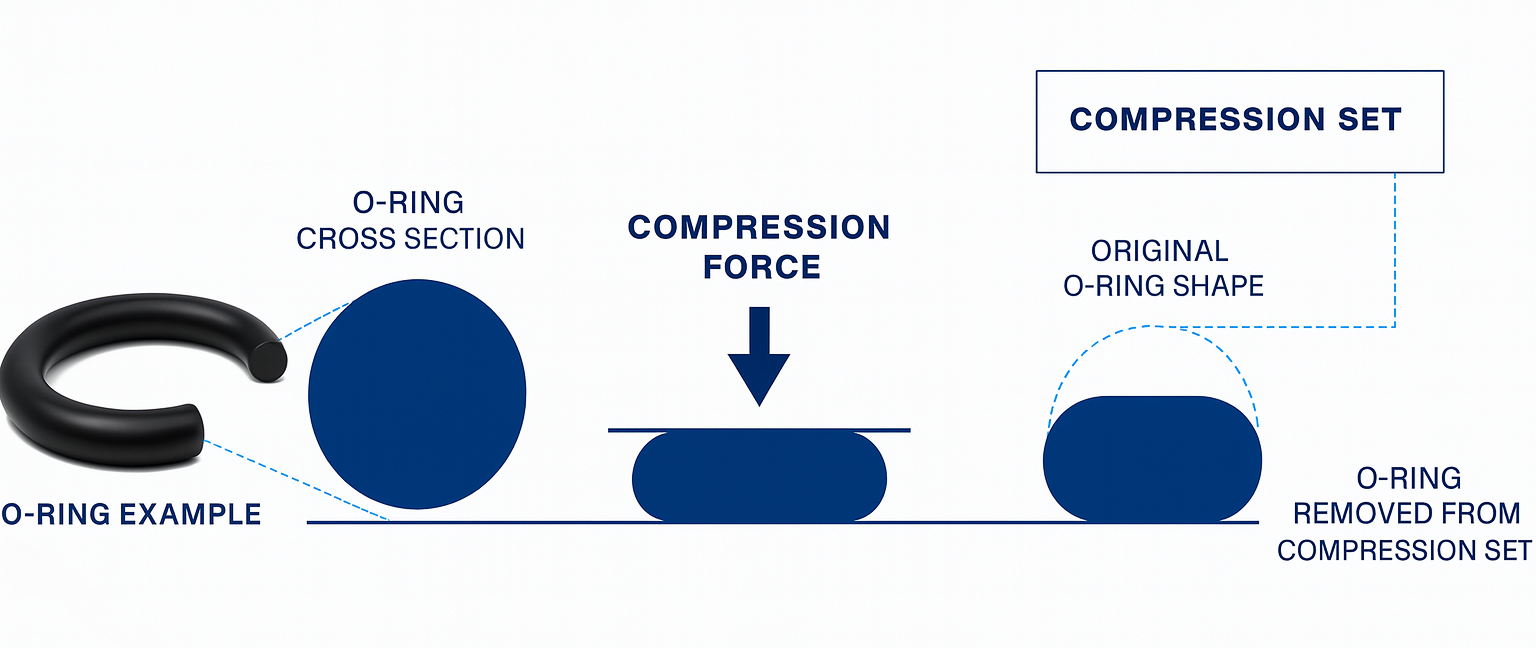
Rubber samples showing compression set after prolonged load.
Compression set refers to the material’s ability to return to its original shape after being compressed. Softer materials may take more compression set, which can weaken sealing ability over time. Harder materials maintain their shape more effectively, making them suitable for constant-load applications such as O-rings, gaskets, and pads. Selecting a hardness that can maintain resilience over long periods is critical for maintaining performance.
Durability Under Stress and Wear

Hard rubber components used in abrasion-intensive applications.
Durability is linked to a balance between hardness, flexibility, and environmental exposure. Soft compounds absorb vibration well but may tear under mechanical stress. Hard compounds resist abrasion and wear but may crack if repeatedly bent or flexed. The correct durometer helps ensure that parts withstand the environmental and mechanical demands of their application without excessive wear.
Performance in Temperature Extremes

Rubber components illustrating hardness changes under temperature extremes.
Temperature fluctuations alter material hardness. Rubber stiffens in cold temperatures and softens in high heat. This is especially important for industries producing custom molded rubber parts in Michigan, where seasonal extremes impact performance. Choosing a hardness that remains stable under a wide temperature range helps maintain reliable function throughout the year.
Pressure Handling and Extrusion Resistance

A T-seal is designed to provide stable, extrusion-resistant sealing in high-pressure systems.
Harder rubber is more resistant to extrusion, making it suitable for high-pressure applications such as pumps, hydraulic systems, and industrial equipment. Softer rubber performs well in low-pressure situations where flexibility matters more than extrusion resistance.
A good example is a T-seal. It’s designed with anti-extrusion elements on both sides, allowing it to handle higher pressures than a standard O-ring. Because of its rigid backup structure, a T-seal maintains shape under load and prevents the rubber from extruding into the gap, which makes it ideal for heavy-duty hydraulic cylinders and high-pressure sealing environments.
Matching hardness and seal design—like choosing a T-seal for high-pressure duties—helps maximize service life and sealing strength.
Common Hardness Ranges by Application
Different applications require different hardness levels to function correctly. Selecting a hardness appropriate for load, pressure, movement, and environmental exposure ensures optimal performance. Below is a general guide to common hardness ranges.
 Choosing the Right Hardness for Your Application
Selecting the proper hardness requires evaluating load, pressure, temperature, movement, chemical exposure, and tolerance stack. Hardness influences sealing life, dimensional stability, and long-term durability. Aligning hardness with application requirements reduces maintenance, prevents failure, and improves performance across industries.
Material hardness plays a big role in how any rubber part performs. If you need help choosing the right durometer for your design or you want us to review a project, you can reach out anytime.
You can contact us or request a quote through our form. You can also email us directly at [email protected]
Related Posts

Silicone and Fluorosilicone, which is best for your application?
Posted on May 2, 2024| Posted in Blog Series
Comparing and Contrasting Viton vs. Kalrez
Posted on May 8, 2024| Posted in Blog Series

The Biggest Misconception About O-Rings and Why It Matters
Posted on August 1, 2025| Posted in News, Blog Series

5 Common Seal Failures and How to Prevent Them
Posted on September 4, 2025| Posted in Blog Series
ASTM D2000 Material Spec
Posted on March 2, 2026| Posted in Material Properties
How to pick and size a Rubber Grommet
January 6, 2014

Comparing and Contrasting Viton vs. Kalrez
May 8, 2024

Which Rubber Material is Right for You?
October 30, 2013
Q4 2008
January 27, 2013

5 Common Seal Failures and How to Prevent Them
September 4, 2025

SAE J200 Material Spec
April 23, 2026

ASTM D2000 Material Spec
March 2, 2026

Everything You Need in a Rubber Properties
January 29, 2026

How Material Hardness Changes Real-World Performance in Rubber Parts
November 13, 2025

Comments