




ASTM D2000 Material Spec
Introduction
ASTM D2000 is a widely used material specification system that classifies rubber compounds based on performance requirements rather than proprietary formulations. It provides a common technical language for engineers, buyers, and manufacturers, ensuring consistency across design, sourcing, and production.
By focusing on measurable physical properties, ASTM D2000 allows flexibility in material selection while maintaining functional reliability.
Purpose of ASTM D2000
The primary purpose of ASTM D2000 is to standardize how rubber materials are specified in engineering drawings and purchase documentation.Instead of referencing a specific compound, the standard defines minimum performance thresholds such as temperature resistance, hardness, tensile strength, and environmental resistance.This approach reduces miscommunication, shortens quoting cycles, and supports multi-supplier sourcing strategies.
Structure of an ASTM D2000 material specification
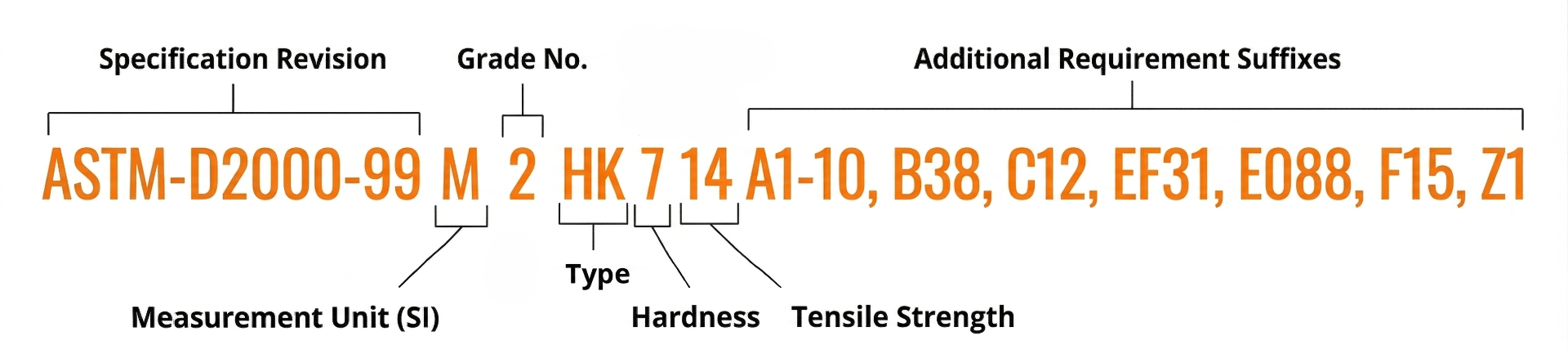 An ASTM D2000 material spec is written as a coded line callout. The letter “M” designates an elastomeric material, followed by a number indicating the temperature range.Subsequent letters identify the elastomer family, while the numbers that follow define minimum physical properties. Optional suffixes specify additional requirements such as oil resistance, heat aging performance, or compression set limits.
ASTM D2000 material spec chart
The chart below illustrates common elastomer families and how they are typically represented under ASTM D2000. Values shown reflect general industry ranges and are intended for reference rather than exact formulation limits.
|
Elastomer Family |
ASTM D2000 Prefix |
Typical Temperature Range |
Key Performance Traits |
Common Uses |
|
NBR (Buna-N) |
M2BG |
-40 °C to +100 °C |
Oil and fuel resistance |
Hydraulic seals, O-rings |
|
EPDM |
M2BA |
-50 °C to +150 °C |
Weather and ozone resistance |
Water systems, outdoor gaskets |
|
Silicone |
M2GE |
-60 °C to +200 °C |
Flexibility, thermal stability |
Medical and food equipment |
|
FKM (Viton type) |
M2HK |
-20 °C to +200 °C |
Chemical and heat resistance |
Aerospace and chemical sealing |
Interpreting the chart
The ASTM D2000 prefix identifies the elastomer family and temperature capability. Additional digits and suffixes in a full material callout further refine performance expectations. This layered structure allows engineers to specify only what is functionally necessary, avoiding over-engineering and unnecessary cost.
ASTM D2000 versus material data sheets
ASTM D2000 establishes enforceable minimum property requirements, while material data sheets typically report average or typical values. For procurement and quality control, ASTM D2000 provides a stronger contractual baseline. Data sheets remain useful for comparative analysis and early design evaluation but should not replace formal specifications.
Application in molded rubber parts
ASTM D2000 material specs are commonly used for O-rings, gaskets, seals, and custom molded rubber components.They enable consistent performance across production runs and suppliers. This is especially important in regulated or high-reliability industries where material substitution must be controlled.
Conclusion
ASTM D2000 material specs offer a clear, flexible, and performance-based approach to defining rubber materials. By using standardized classifications and minimum property requirements, manufacturers can reduce risk, control cost, and maintain consistent quality. For any application involving elastomeric components, ASTM D2000 remains a foundational specification standard.
Related Posts

Silicone and Fluorosilicone, which is best for your application?
Comparing and Contrasting Viton vs. Kalrez

The Biggest Misconception About O-Rings and Why It Matters

5 Common Seal Failures and How to Prevent Them

How Material Hardness Changes Real-World Performance in Rubber Parts




Comments